How FAMI-QS Certification Affects Feed Additive Manufacturing Equipment
Consistency, traceability, and contamination control become closely connected once feed additive production moves toward FAMI-QS certification. Equipment choices affect more than throughput; they also influence weighing records, batch uniformity, cleaning procedures, and audit evidence. Within this framework, feed mill equipment must be evaluated against both processing performance and quality-system requirements. FAMSUN’s mixing technologies illustrate how mechanical design supports these operational considerations without making equipment the sole focus of certification.
Understanding FAMI-QS Audit Expectations
FAMI-QS certification focuses on the controlled production of specialty feed ingredients and additives, with attention extending from raw-material management to finished-product release. Documentation, risk assessment, supplier controls, traceability, and process monitoring all form part of the wider quality framework.
Equipment choices matter because manufacturing records need to reflect what actually happens on the production floor. Batch identification, ingredient quantities, processing parameters, cleaning activities, and maintenance events should be linked through controlled procedures.
Consequently, feed machine selection should reflect audit requirements into account from the beginning. Accessibility, measurement capability, material compatibility, and cleanability all affect how easily documented procedures are translated into routine production.
Mixing Accuracy And Batch Uniformity
Mixer performance matters because additive formulations may contain components used at very different inclusion rates. Poor distribution can create nutritional variation even when individual weighing steps appear accurate.
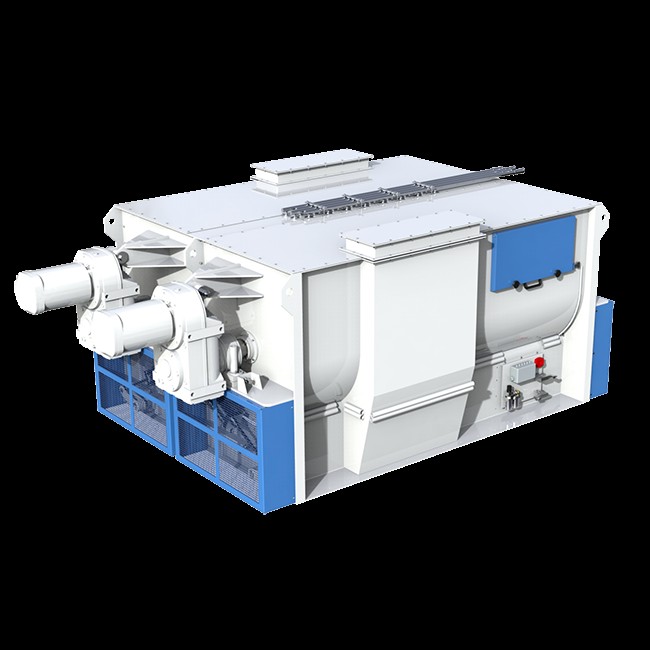
FAMSUN’s SLHY(ZL) Series Twin-Shaft Ribbon Mixers are designed for mash mixing and achieve a mixing homogeneity coefficient of variation of ≤5% within 90–120 seconds under the specified test method. Testing references the methyl violet method under GB/T 5918, with materials and procedures referring to GB/T 32536.
These performance figures should be considered alongside actual formulation characteristics. Particle size, density, moisture, fill level, sequence of addition, and mixing time can all influence uniformity, making process validation more meaningful than relying solely on nominal mixer specifications.
Weighing Calibration And Measurement Control
Precision starts before ingredients enter the mixing chamber. Micro-components, carriers, minerals, and other additives may require different weighing ranges, so measurement devices should be selected according to their intended operating conditions.
Calibration programs should define equipment identification, reference standards, acceptable tolerances, inspection intervals, and procedures for handling deviations. Records should remain traceable to the relevant production period rather than existing as isolated maintenance documents.
A well-documented feed mill equipment control system connects calibration status with batch production. Such linkage makes it easier to investigate whether an out-of-tolerance measurement could have affected previously manufactured material.
Cleaning Validation And Cross-Contamination
FAMI-QS-oriented production requires attention to hygiene and cross-contamination risks, particularly where multiple additives or formulations pass through shared equipment. Residual material can remain inside transfer lines, mixer surfaces, discharge areas, or other difficult-to-access locations.
Cleaning procedures should identify the equipment zones requiring attention, specify cleaning agents or methods, and establish inspection criteria. Validation may involve residue testing or other evidence demonstrating that the selected procedure performs as intended under defined conditions.
Equipment geometry deserves practical consideration. Smooth product-contact surfaces, accessible inspection points, effective discharge arrangements, and suitable sealing simplify routine sanitation and reduce uncertainty during cleaning verification.
Maintenance, Records And Audit Evidence
Mechanical reliability and documentation cannot be treated as separate subjects during an audit. Preventive maintenance schedules should identify critical components, inspection frequency, responsible personnel, and records required after servicing.
Changes to equipment or process parameters also require controlled review. Replacing a mixer component, modifying dosing settings, or altering a cleaning procedure affects validated conditions and may require assessment before routine use.
For this reason, feed machine documentation should extend beyond operating manuals. Equipment specifications, maintenance history, calibration records, cleaning records, deviations, corrective actions, and relevant validation evidence should form a coherent record trail.
Building An Audit-Ready Production System
Certification becomes easier to manage when quality controls are integrated into daily production rather than treated as paperwork prepared before an audit. Operators should understand which measurements require recording, which deviations require escalation, and how cleaning or maintenance activities affect subsequent batches.
Risk-based thinking helps prioritize resources. Critical weighing devices, high-risk ingredients, shared product-contact surfaces, and processes with greater contamination potential generally deserve closer monitoring than low-risk activities.
FAMI-QS compliance is not simply an equipment-purchasing exercise. Suitable feed mill equipment provides useful technical foundations, but consistent procedures, competent personnel, validated methods, and reliable records determine how those capabilities translate into an auditable quality system.
Conclusion
FAMI-QS certification connects manufacturing technology with documented control. Mixing uniformity, weighing calibration, cleaning validation, maintenance, and traceability each contribute a different part of the compliance picture, while weaknesses in one area can complicate investigations elsewhere.
Rather than selecting machinery around capacity alone, additive manufacturers can assess how each component fits the intended quality system. FAMSUN‘s mixer technology shows how defined mixing performance fits alongside calibration, sanitation, and documentation requirements. Viewed as part of the wider process, feed machine design becomes one practical element within a structured approach to FAMI-QS readiness.