
Malaria Lab Test Selection Guide for Clinical and Reference Laboratories
The intended report gives malaria test selection a practical starting point in both clinical and reference laboratories. A malaria test kit may measure parasite antigens, while a separate molecular method detects parasite DNA. These observations arise from different analytical procedures and retain their own interpretation requirements. Referral status alone does not decide between those measurements: the requested finding does.
Specify the Finding the Service Needs
A clinical request can seek a timely antigen finding, whereas a reference request can seek a molecular observation or another separately defined investigation. Either service may use more than one method; the laboratory’s name does not substitute for an explicit analytical objective. Defining the requested output establishes the question against which an assay can be assessed.
The question assigned to a malaria lab test can be recorded before products are compared. The chosen malaria test kit needs a stated analyte and specimen, together with a procedure that produces the requested finding. Package contents and equipment requirements become relevant within that defined task, rather than determining the analytical question merely because a product is available.
Qualitative detection identifies whether target evidence meets the method’s interpretation criteria. It is distinct from measuring parasite concentration or identifying every species within a combined target category. A laboratory requiring either additional result needs a method whose stated output includes it, rather than expecting more detail from an unchanged qualitative procedure.
Connect Each Marker with Its Measurement
Antigen recognition and DNA amplification act on different components of parasite material. The first approach produces an antigen finding; the second examines selected genetic sequences. A shared disease name does not collapse those molecular questions into a single measurement, even when the starting specimen is whole blood.
Antibodies incorporated into an antigen device recognize selected parasite proteins. Their interaction with the target produces the test’s antigen-dependent signal. PCR follows another mechanism: selected DNA sequences are amplified and detected during the reaction, linking the molecular observation to its genetic target rather than to the antigen-binding system.
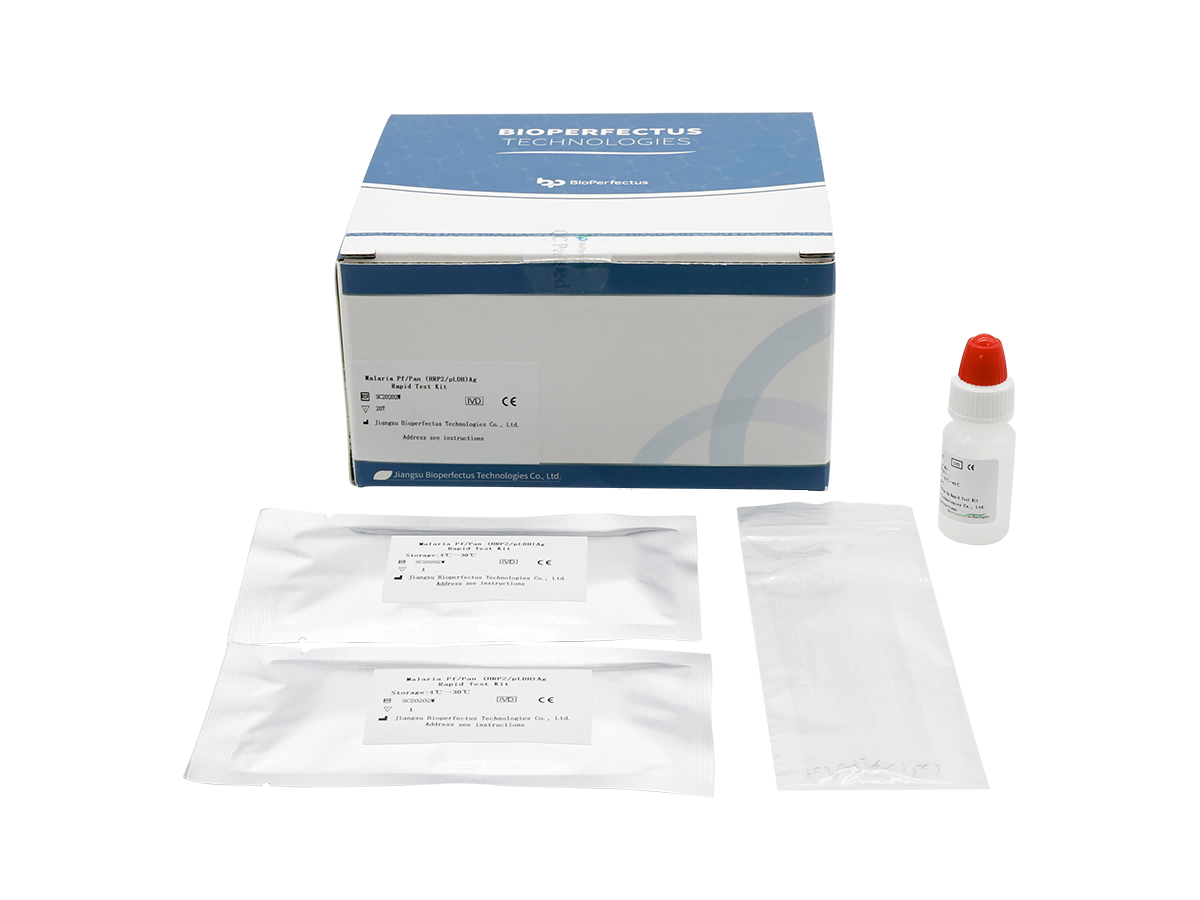
Two antigen markers underpin the Malaria Pf/Pan (HRP2/pLDH) Ag Rapid Test Kit supplied by BioPerfectus: Pf-specific HRP2 and Pan pLDH. The former is histidine-rich protein 2 from Plasmodium falciparum; the latter is Plasmodium lactate dehydrogenase. Their identification explains the biological substances behind the two antigen readouts.
In a malaria lab test, a Pan designation needs its product-specific meaning. For this antigen assay it covers Plasmodium falciparum, Plasmodium vivax, Plasmodium ovale and Plasmodium malariae. A combined Pan result is not a set of four individually identified species results, so the report retains the assay’s defined marker categories.
Make the Rapid Test a Complete Procedure
Handling, timing and control assessment belong to the same rapid-test procedure. A device produces an interpretable observation through its specified use, rather than through elapsed time alone. Materials, the accepted specimen and the reading instructions therefore enter implementation together, with any qualification retained when the finding is recorded.
Human whole blood enters the BioPerfectus rapid kit’s three-step procedure, which provides a result within 15 minutes. A built-in control mechanism supports result validity. Control acceptance and antigen interpretation retain their separate roles when the result is reviewed.
A control observation has a position within the procedure. A control assessed during the rapid test is not evidence that a separate extraction or PCR reaction succeeded. Each method retains the observations and acceptance rules belonging to its own steps, even when both methods address the testing request.
A stated result interval also differs from the time needed to receive a specimen, prepare the workspace and complete professional review. Staff availability and the route for communicating the finding affect the wider service. These local arrangements can be assessed without attributing them to the test kit as built-in functions.
Keep Molecular Detection Distinct from Antigen Testing
DNA testing adds a separately specified laboratory pathway to the available malaria investigations. Whole-blood material must reach the amplification reaction through an applicable preparation method. The extraction procedure, reaction requirements and internal controls form a molecular workflow, rather than additional steps that can be assigned to an antigen device.
Extraction prepares nucleic acids within surroundings suitable for the receiving reaction. Blood-associated material carried into PCR can interfere with amplification, so preparation concerns more than recovering a liquid. The extraction and assay procedures determine how that prepared material reaches the test, with controls interpreted for their assigned roles.
The Plasmodium DNA Real-Time PCR Kit from BioPerfectus detects parasite DNA with stated coverage of Plasmodium vivax, Plasmodium falciparum, Plasmodium malariae, Plasmodium knowlesi and Plasmodium ovale. Its included internal control belongs to that molecular procedure. Coverage identifies the organisms addressed, without establishing that each receives a separate species report.
A malaria test kit assessment can now distinguish antigen testing from a DNA-based malaria lab test without ranking every use case on one scale. The relevant comparison includes the requested observation, accepted material, reaction procedure and available laboratory resources. Additional species characterisation remains a separate task wherever the selected assay has not established that reporting capability.
Clinical and reference test menus can accommodate different measurements of the same infection. A method earns its place through the finding it is specified to provide and the procedure that produces it. Pf/Pan antigen observations retain their marker identities, while a Plasmodium DNA result remains a molecular finding.